The 2025–2026 Social Innovation Lab (SIL) cohort brought together 13 student and community founders developing ventures focused on mobility access, workforce development, education, community support, and creative ecosystems. Hosted by the Pava Marie LaPere Center for Entrepreneurship at Johns Hopkins University, the showcase highlighted how early-stage founders are applying entrepreneurial approaches to address social and environmental challenges across Baltimore and beyond.
This year’s showcase concluded with awards recognizing ventures for both their impact potential and their growth throughout the program.
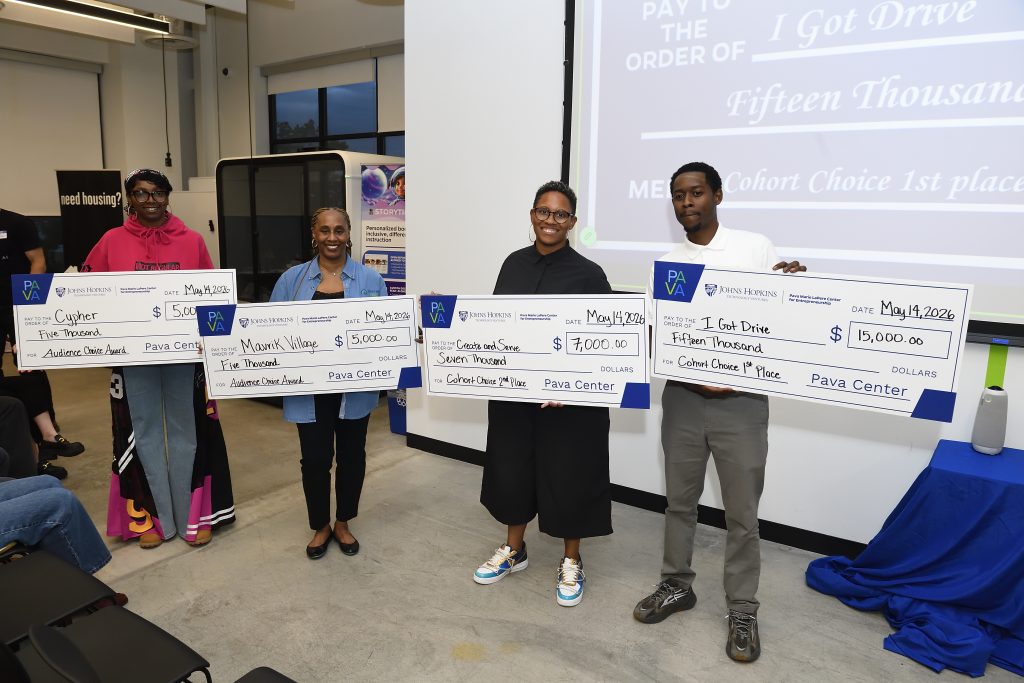
First place and a $15,000 award went to Eean Logan (BSPH ’23) of I Got Drive, a venture combining a for-profit driving school with a nonprofit foundation to turn driver education into a pathway toward economic mobility, workforce readiness, and lasting personal well-being.
Second place and a $7,000 award went to Alexandria Queen-Sneed of Create & Serve Media, which is a storytelling production company that delivers high-quality content while cultivating Baltimore’s existing pool of film and media professionals through a tiered, adult-focused, workforce development model entitled Crew Call.
Two ventures also received Audience Choice Awards for $5,000 each: Mavrik Village and Cypher.
Logan, of I Got Drive, explained the venture grew from personal experience and a broader recognition of transportation access challenges facing young people.
“The concept originated from teaching youth driving during community organizing,” Logan said. “Students lacked access to driving education and permits.”
What began as scholarship support for driving instruction evolved into a larger effort to build both a dedicated driving school and supporting technology platform aimed at expanding access and opportunity.
Logan said the SIL experience helped sharpen both the venture’s business model and long-term vision.
Second-place winner Create & Serve was founded out of a desire to strengthen Baltimore’s creative economy and support local talent pursuing careers in entertainment and media.
“What motivated me is knowing how hard my journey was getting into this industry,” Queen-Sneed said. “I wanted there to be a way for us to grow entertainment in our city without making everybody move away.”
Queen-Sneed described the program as an opportunity to gain confidence as both an entrepreneur and leader while developing clearer operational goals and metrics.
“I think the top thing I got from the SIL experience was understanding the importance of metrics but also leaning into who you are as a founder,” Queen-Sneed said.
Audience Choice Award recipient Mavrik Village was recognized for its work focused on entry-level, affordable, low-barrier, long-term housing and wraparound services in a homelike environment for formerly incarcerated individuals. The founder said the venture began after identifying a gap in support services while working in Baltimore communities for more than two decades.
After acquiring an investment property, the founder decided to use a vacant apartment as a starting point to provide support and housing resources, initially furnishing the space independently and connecting directly with organizations across Baltimore.
Waunita Scott said participating in the SIL pushed them to think differently about scaling and storytelling.
“It stretched me in so many ways,” Scott said. “I learned from watching how other founders pitch, different business methodologies, and from all the speakers.”
 The second Audience Choice winner Cypher, focused on a 3-in-1 model for holistic, culturally responsive instruction that integrates mindset development, social-emotional learning, and content mastery through the four pillars of hip-hop. The idea came about from the founder’s experiences in education and student engagement.
“In my first year of teaching, I found that engagement was one of the challenges connected to student performance,” Fite said. “I started listening to students to figure out how I could design something they would actually want to do.”
Fite found it beneficial to learn alongside founders at different stages of company development and receiving feedback that helped transform an early idea into a more fully developed business concept.
The SIL is designed to support ventures addressing social and environmental challenges through entrepreneurship, mentorship, and community-building. Throughout the program, founders refine their business models, receive coaching from experienced mentors, and build connections across the Johns Hopkins and Baltimore innovation ecosystems. Each venture received $5,000 after completing the program.
This year’s showcase reflected the breadth of ideas from transportation access and education to housing support and creative workforce development, while underscoring the growing role entrepreneurship can play in advancing community-centered solutions.
Applications for the next SIL cohort will open in August. Subscribe to the SIL Newsletter to be the first to know.
2025-2026 SIL Cohort Ventures
Afya Counseling and Wellness: A wellness initiative that integrates mental health, nutrition, and cultural healing by transforming the act of cooking into a therapeutic practice for Baltimore communities facing food insecurity, trauma and health disparities.
Ari Wellness: A Pilates-based movement studio that helps individuals with hypermobile Ehlers-Danlos Syndrome (hEDS) improve strength, proprioception, and quality of life through a specialized movement protocol.
Crew Call: A storytelling production company that delivers high-quality content while cultivating Baltimore’s existing pool of film and media professionals through a tiered workforce development model.
Cypher: A 3-in-1 model for holistic, culturally responsive instruction that integrates mindset development, social-emotional learning, and content mastery through the four pillars of hip-hop.
Dari Health: A digital agent that integrates with the hospital record systems to guide patients, especially those facing language and technology barriers, through Medicaid renewals and other Baltimore community resource applications.
Dirtbag Goods: Affordable, home-compostable single-use products starting with toothpaste tubes made from Baltimore’s food waste that perform like plastic but break down in backyard bins and gardens within 90 days.
HealthLink 360: A preventive health platform that turns everyday health data into clear, contextualized guidance routing people to care when needed.
I Got Drive: A for-profit driving school and nonprofit foundation that provides driver’s education as a gateway to economic mobility, essential workforce and character development skills that lead to financial stability and personal well-being.
Mavrick Village: Entry-level, affordable, low-barrier, long-term housing and wraparound services in a homelike environment for formerly incarcerated individuals.
Ovelia Health: A clinically-backed PCOS screening and support app for menstruating women to solve the problem of 70% undiagnosed cases by providing a novel risk percentage calculator and care management tools.
Reentragent: An ecosystem that provides meaningful career opportunities for returning citizens in environmental sustainability while helping them navigate services and track progress using an AI-powered reentry case manager.
Storytime AI: K-12 reading platform that helps close the literacy gap by empowering educators and students to generate personalized, science of reading-aligned content that reflects learners’ identities.
The Fair Transitions Standards Forum: A transition forward standards body developing equity-centered, science-based frameworks and certifications to prepare organizations and corporations for the 21st century and beyond; toward a fair and inclusive decarbonized economy.