
Johns Hopkins Technology Ventures (JHTV) and the Johns Hopkins School of Medicine convened faculty, students, alumni, and industry leaders for the 2026 Celebration of Innovation in Medicine. This event is designed not just to recognize scientific achievement, but to underscore that discovery alone is not enough.
“To realize the ultimate potential of our institution…we must ensure our innovations reach the people who need them,” said Theodore DeWeese, MD, Dean of the Medical Faculty and CEO of Johns Hopkins Medicine.
This year’s awards recognize leaders whose work exemplifies innovation, from early discovery to global impact. Together, they reflect the various stages and pathways through which research reaches patients.
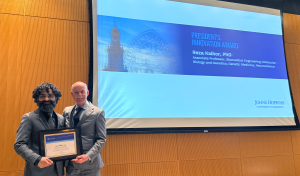 The $250,000 President’s Innovation Award acknowledges early- to mid-career faculty translating breakthrough discoveries into real-world solutions. It was presented to Reza Kalhor, PhD, for his genomic recording technologies that allow scientists to connect biological events across time. By enabling researchers to trace how early biological signals influence disease, his work has the potential to transform how researchers study disease progression, aging, and cellular behavior, with applications in next-generation therapies and precision medicine.
Describing efforts to convert biological signals into durable DNA records that can be analyzed long after they occur, Kalhor said, “I’m really excited to bring these technologies to addressing important questions in aging, cancer, and birth defects.”
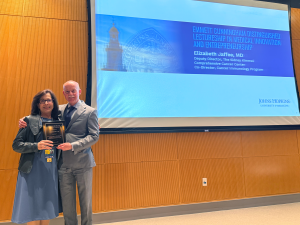 The Emmett Cunningham Distinguished Lectureship in Medical Innovation and Entrepreneurship, made possible through the support of entrepreneur and Johns Hopkins alumnus Emmett Cunningham, highlights leaders who have successfully bridged academic discovery and commercialization. Elizabeth Jaffee, MD, an internationally recognized leader in cancer immunotherapy, delivered this year’s lecture. Jaffee’s work has reshaped the understanding of pancreatic cancer and advanced immune-based treatments, including therapeutic cancer vaccines.
Her lecture emphasized that innovation is inherently collaborative. “One person doesn’t accomplish what is really important in innovation,” she said. “It’s who you work with.”
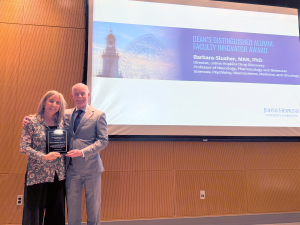 The Dean’s Distinguished Faculty Innovator Award, created to elevate the importance of academic translation, honors faculty whose careers have produced sustained impact through commercialization. With more than 100 patents and multiple FDA-approved therapies, this year’s recipient, Barbara Slusher, MAS, PhD (SOM ’91), has helped define how discoveries move from academic labs into the clinic. As director of the Johns Hopkins Drug Discovery Program, she has built one of the university’s most integrated drug development enterprises, helping move discoveries from concept to clinic.
“Innovation never…is the work of a single person,” said Slusher. “It really takes a village.”
The Dean’s Distinguished Alumni Innovator Award recognizes graduates who have extended Johns Hopkins’ impact beyond campus. As a biotech executive and former CEO of Sentessa Pharmaceuticals, this year’s honoree, Saurabh Saha, MD, PhD (SOM ’04), has led the development of novel therapies and guided companies from early discovery through commercialization.
Reflecting on his time at Johns Hopkins, Saha explained the institution’s unique integration of research, clinical care, and education. “You’re reminded all the time that there’s a patient at the end of all this,” he said. “That shapes how you think about the work.”
Following the award presentation, Saha joined Christy Wyskiel, executive director of JHTV, for a fireside chat that offered a candid look at the realities of building and scaling biotech companies. The conversation explored the full lifecycle of innovation and the critical decisions that determine whether an idea ultimately reaches patients.
Saha emphasized that success in this space requires more than strong science. “Scientists ask, ‘Is it true?’ Entrepreneurs ask, ‘Does it matter?” underscoring the importance of aligning research with real-world need and market viability. He also highlighted the role of clear communication in securing investment, explaining that even the most promising discoveries need compelling data and a clear path to impact.
The discussion also addressed the challenges inherent in biotech innovation, including failure, capital constraints, and the need for rigorous, data-driven decision-making. For researchers and trainees in the audience, the message was direct: understanding the business of science, alongside the science itself, is essential to translating discovery into meaningful outcomes.
Over the past decade, JHTV has played a vital role, helping faculty protect intellectual property, navigate commercialization pathways, and connect with industry partners. The School of Medicine generates most of the university’s inventions, making this collaboration critical to translating research into impact.
There has also been a cultural shift. Careers in industry, venture, and startups are increasingly recognized as essential extensions of academic research, not departures from it. As DeWeese noted, these paths are “not just viable, [but] highly meaningful” for advancing human health.
As the event concluded, attendees were reminded of the broader mission: to ensure that the breakthroughs emerging from Johns Hopkins do not remain confined to publications or laboratories but instead improve lives at scale.
The Celebration of Innovation is more than an awards ceremony. It reflects how Johns Hopkins defines innovation and where it is headed next.
Learn more about Kalhor’s President’s Innovation Award win in the recent Hub article.