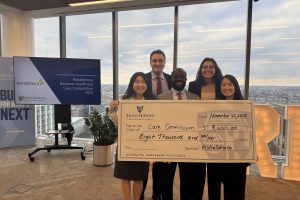
The Johns Hopkins Technology Ventures (JHTV) Commercialization Academy equips doctoral, medical, and business students with the skills and experience needed to bring innovative ideas to market. Recently, those benefits were on full display when four fellows—Vania Wang, Sarah Graham, Jacob Blum, and Andy Charlorin —led their team, CareContinuum, to a first-place finish at AstraZeneca’s National Healthcare Case Competition.
This year’s challenge focused on advancing equitable access to cutting-edge therapies while balancing sustainability and cost-effectiveness. The competition challenged participants to develop solutions addressing critical gaps in healthcare delivery. CareContinuum impressed judges with a comprehensive strategy focused on improving continuity of care for patients navigating complex treatment pathways. Their proposal combined scientific insight with business acumen, reflecting the interdisciplinary strengths of the team.
“Our experience in the Commercialization Academy played a monumental role in our success,” said Sarah Graham, PhD candidate, cellular and molecular medicine. “It gave me the tools to think strategically about commercialization and market impact, which directly shaped our approach to the case.”
The Academy is a year-long fellowship program that immerses participants in the world of technology commercialization. Fellows gain hands-on experience in evaluating technologies, conducting market research, and supporting JHTV’s mission to translate Johns Hopkins innovations into real-world solutions.
Key benefits for participants include:
- Exposure to the full commercialization process, from invention disclosure to licensing.
- Mentorship from experienced professionals in technology transfer and business development.
- Opportunities to build transferable skills in market analysis, intellectual property, and strategic planning.
“This win reflects the caliber of talent and training within the Commercialization Academy,” said Anna Gonye, portfolio operations manager at JHTV and head of the fellowship program. “Our fellows are not only learning the fundamentals of technology transfer and commercialization—they’re building upon those skills to solve critical problems in healthcare.”
The team attributes their win to collaboration and the diversity of their expertise. “We approached the challenge like a startup,” said Graham. “Our shared passion for learning and willingness to push beyond our comfort zones made this possible.”
For Vania Wang, PhD candidate, cellular and molecular medicine, the competition was a natural extension of her Academy experience. “Without the Commercialization Academy, I wouldn’t have had the courage to apply or the skills to bring a winning strategy to the intersection of business and science. The program taught me how to diligence technology and build a network of equally driven teammates.”
Andy Charlorin, MBA candidate, health, technology, and innovation pathway, emphasized the importance of team dynamics. “Diversify your team because that’s what made us stand out. We come from consulting, medicine, cancer research, and nursing—those perspectives led to a well-rounded solution.”
The fellows also highlighted how Academy training prepared them for the challenge. “Weekly diligence on unfamiliar technologies taught us to quickly get up to speed on complex topics,” Graham noted. “The emphasis on communication and structured thinking was essential.”
Beyond the win, the team sees momentum for future collaborations. “We’re open to another case competition,” Charlorin said. “Most importantly, we grew our friendship over preparation.”
The Commercialization Academy continues to serve as a launchpad for innovators, preparing them to navigate the intersection of science, business, and societal impact. CareContinuum’s achievement underscores the program’s role in fostering leaders who can translate ideas into solutions that improve lives.
Interested in learning more or applying? Visit the Commercialization Academy page for details.