There is a narrative in startups that founders ‘take a leap,’ the moment they walk away from a stable position, paycheck, or path, and commit to building a company.
In reality, that moment is harder to pinpoint.
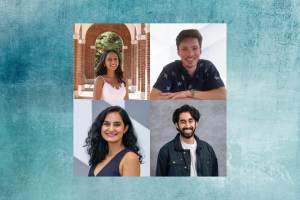
For three Johns Hopkins startups, ProCounsel, Modelus, and Heisler Semiconductor, going full time was not a single decision. It was the result of gradual momentum, repeated course correction, and eventually, enough evidence to make the risk feel less like a leap and more like a next step.
While interning in a public defender’s office, ProCounsel founder, Iris Gupta (WSE ’25), said she watched attorneys spend hours sorting through legal discovery manually.
 “Everything was getting printed,” Gupta said. “I was sitting on the floor sorting stacks of pages by hand.”
At the same time, Gupta was conducting AI research through the ARCADE Lab, where she worked on projects involving user studies, front-end design, and Python scripting. The overlap between those two experiences began to shape the foundation for ProCounsel.
At Modelus, founders Prem Umang Satyavolu (MBA ’25) and Mantej Singh encountered a different kind of bottleneck. In drug development, organoid models (miniaturized, lab-grown versions of human tissue) hold promise, but are difficult to standardize and scale.
“We started with a completely different idea,” Satyavolu said. “Then we talked to multiple scientists and learned there was a small hole in the space that no one was talking about.”
That realization came just before the FDA announced its push toward non-animal models in drug development. The timing was ideal.
 Jacob Heisler focused on issues in an industry he knew well. After years working in his family’s electronics manufacturing business, he thought something was missing.
“I was the engineering manager of my family business,” he said. “I wanted them to invest in more cutting-edge technology, but my family disagreed.
Ultimately Heisler made the decision to pursue something independently.
Early versions of each company looked different from what exists today.
Gupta’s first ideas focused on using AI to flag predatory clauses in housing contracts. After discussing the concept with AI professors, she realized the technical barriers were too significant for an early-stage startup. The next iteration used AI to recommend legal defense strategies based on discovery documents. That concept also met resistance around trust in AI systems. That feedback led ProCounsel to center on automating administrative tasks tied to legal discovery review.
“We landed on filtering out irrelevant information, sorting and summarizing discovery, and pulling trends out of documents,” Gupta said. “This is work lawyers, paralegals, and interns spend weeks doing manually.”
Modelus went through a similar process. Over the course of more than 100 interviews for customer discovery, the founders encountered consistent skepticism around AI. The turning point came when they repositioned their approach.
 “If we’re going to use organoids, let’s not try to replicate the organoid behavior,” Singh said. “Let’s build something surrounding how it helps validate the models and build the infrastructure around this technology.”
The shift reframed Modelus as a tool to improve scientific workflows.
Although Heisler felt that his family raised him with the intention he would take over the business, he found it necessary to venture out on his own.
“I decided for my career it was the best option,” he said. “This company [is] willing to take on the risk that they weren’t willing to.”
The shift to working full time only became viable once each company found a form of traction that extended beyond the idea.
A combination of funding, pilot programs, and growing interest from legal professionals persuaded ProCounsel. After initially focusing on public defender offices, Gupta began hearing from lawyers in other practice areas. The company later secured a pilot with the Montgomery County Public Defender’s Office, where attorneys tested the platform over several months.
“We made the pilot unpaid, but in exchange they filled out user studies and gave us testimonials so we could use that data to improve the product and show value to other firms,” Gupta said.
Plus, with approximately $200,000 in grants funding, ProCounsel had the capital to move forward.
 “There wasn’t really an ‘aha’ moment for me,” Satyavolu said about Modelus. “It was just grueling days, for months on end, finding different parts of the platform that work.”
Singh saw validation through retrospective testing conducted with customers.
“If we were trying to detect variability early on, our platform could pick up certain traits before a human observer did,” he said. “That translated to thousands of dollars in savings for companies.”
Traction showed up early and clearly for Heisler Semiconductor.
“Within that first month we had paying customers,” Heisler said. “When I started the business, we had sales and then we just kept rolling from there.”
The company has continued to grow primarily through referrals rather than traditional marketing, which translated into strong retention.
“When customers keep working with you, that tells you you’re solving something real,” he said, pointing to a client base of more than 30 companies and a retention rate above 90 percent.
AI plays a role in Heisler Semiconductor’s work, but it is largely in the background. Instead, the focus is on improving how manufacturing systems function.
 “Currently it takes a PhD to run tools in this ecosystem,” Heisler said. “Let’s make it easier.”
In practice, that means reducing time-intensive manual work.
“One of our processes… initially I spent a whole day collecting data,” he said. “But right now I can do that in an hour.”
Even with traction, the decision to go full time is rarely immediate.
Gupta accepted an offer from an investment firm. That changed during her senior spring semester, when she converted to going to school part time and began spending significantly more time building the company.
“I was able to build and iterate with my tech team faster,” she said. “We were getting a lot more traction from lawyers and a lot more interest.”
The Modelus team had both momentum and timing on their side. As investment and regulatory attention around non-animal models increased, the founders felt they had entered the market early enough to establish a meaningful position.
Before pursuing entrepreneurship, Satyavolu planned to pursue a PhD in clinical psychology.
“I realized that while research is very important, I wanted to develop solutions that reached patients faster,” she said.
For Singh, entrepreneurship had long been an interest, though not necessarily in biotech.
“I always thought I’d end up working for a tech company after graduating,” he said. “I never really thought about building a company.”
The shift for Heisler was tied directly to its financial viability.
“There’s a level of uncertainty that comes with starting something from scratch,” he said. “But once we had revenue coming in, it became a different kind of decision.”
Rather than questioning whether the company could work, the focus shifted to how far it could grow.
Gupta said the company began to feel less like a student project.
“We started setting up standup calls with the tech team every day,” she said. “We had deliverables and roadmaps. That’s when it started feeling like an actual company.”
Satyavolu explained that Modelus’s day-to-day centers on customer development and pilots.
“My focus right now is getting initial customers for pilot programs and turning them into long-term customers,” she said.
Singh remains focused primarily on technical development, often building prototypes and demos for customers.
Heisler immediately reinvests its revenue.
“Any money we collect, we’re throwing it right back into R&D,” he said. “If we don’t invest, we can’t grow, and if we can’t grow, we can’t continue to bring in more customers or hire more people.”
As these startups have proven, going full time is not defined by a single ‘leap.’ It is the result of accumulating evidence from user adoption, customer alignment, or financial traction, that reduces uncertainty.
AI may be a common thread across these companies, but it is not what defines them. What does: how founders respond to feedback, adjust their approach, and recognize when they have enough proof to move forward. The question is not whether the idea is worth pursuing, but how to build something that lasts.