When COVID-19 shut down travel and in-person care in 2020, millions of patients, particularly in rural communities, lost access to essential eye care services. For Jordan Shuff and her co-founders —Nakul Shekhawat, an ophthalmologist at the Wilmer Eye Institute, and Kunal Parikh, a professor at Wilmer and the Center for Bioengineering Innovation and Design— who had longstanding partnerships with eye hospitals in India, the disruption exposed a critical gap: how do you deliver quality care when patients can’t reach providers?
What emerged from that moment was Visilant, a nonprofit working to bring clinical-grade eye exams directly to underserved communities using a combination of telemedicine, smartphone-based imaging, and artificial intelligence.
Shuff began developing Visilant while she was a student, drawing early support from the Pava Center. Through workshops, mentorship, and hands-on programming, the Pava Center helped her navigate the fundamentals of building a venture beyond the technical solution.
Before the pandemic, organizations like Aravind Eye Hospital relied on large-scale outreach events known as “Eye Camps” to screen hundreds of patients in a single day. When those stopped, community members stepped in, taking photos of patients’ eyes on their phones and texting them to doctors. The effort was well-intentioned, but fragmented and inconsistent. Visilant’s first step was to bring structure to that chaos.
“We were seeing this incredible, grassroots response—people trying to help their neighbors—but it was completely uncoordinated,” said Shuff. “The question became: how do we provide order to that chaos and make sure every patient gets the care they need?”
 The team developed a basic telemedicine platform that allowed community volunteers to securely capture and share patient information with clinicians. A pilot study of roughly 500 patients confirmed that diagnoses made through the platform were both safe and clinically accurate.
But a major limitation quickly surfaced: about half of the images being submitted were unusable.
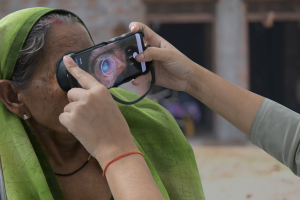
To address the imaging challenge, Visilant developed Seeker™, a low-cost smartphone attachment that enables users (without medical training) to capture high-quality images of the eye.
The device integrates magnification and specialized lighting to replicate key functions of a traditional slit lamp, a tool typically found only in clinical settings. But unlike conventional equipment, Seeker is designed specifically for community use: simple, portable, and intuitive.
Rather than miniaturizing a complex clinical tool, the team focused on identifying only the essential features needed for screening and diagnosing in low-resource settings.
“In a community setting, you don’t need everything; you need to know what disease a patient has and where they need to go,” Shuff explained.
The result is a device that can be learned in minutes, not years.
Getting there required more than 30 iterations, with prototypes tested in real-world settings and refined continuously based on how community users, not clinicians, interacted with the device.
As Visilant scaled its telemedicine platform, it also built a substantial dataset, now totaling around 200,000 clinically labeled eye images.
That dataset became the foundation for the company’s next evolution: artificial intelligence.
Because diagnosing eye disease is inherently visual, the dataset enabled early AI models to exceed 80% accuracy, demonstrating the potential to triage patients at scale, a performance that has continued to improve with use of advanced AI techniques.
Today, Visilant is leveraging AI to triage cases by automating the identification of routine conditions while directing more complex cases to specialists. This approach increases efficiency and allows limited clinical resources to reach more patients.
From the outset, Visilant made a deliberate decision to operate as a nonprofit. The goal: prioritize access over profit, particularly for patients who are often excluded from traditional healthcare markets.
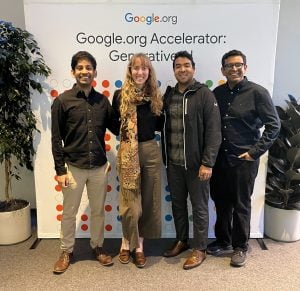
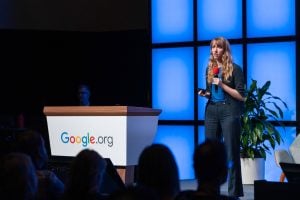 Rather than pursuing venture capital, the team has relied on philanthropic support. A major milestone came with a $1.5 million award from Google.org’s Generative AI Accelerator, which selected Visilant as one of just 20 teams from more than 3,000 applicants.
The funding enabled the team to establish scalable manufacturing of the Seeker device in India, expand deployment across new sites, advance toward FDA clearance, and accelerate AI development with technical mentorship.
Despite its nonprofit status, Visilant operates with the urgency of a startup, driven by the reality that delayed care can lead to preventable blindness.
Now part of the Pava Center’s alumni cohort, Shuff sees her journey as full circle now mentoring the next generation of founders.
With core technologies validated, Visilant is focused on scale. That includes integrating its tools into public health systems, expanding into primary care settings, and forming government partnerships to reach broader populations.
In the early stages of building Visilant, the team faced constant pressure to pursue new ideas and partnerships. The lesson, Shuff says, was learning to stay focused.
That discipline, combined with a commitment to accessibility, continues to shape Visilant’s trajectory.